Kya's Isolation
Where the Crawdads SingKya’s Isolation is the condition left by repeated abandonment and reinforced by Kya’s decision to protect herself from further hurt. After Tate Walker leaves, grief drives her from bed to the beach and then into a month of near-total withdrawal; in the years that follow, her collections and routines give solitude structure, but do not make it painless. When Jodie Clark returns, Kya describes isolation not as an abstraction but as a life she has inhabited, while trying to understand the family losses that shaped it.
After Tate Walker Leaves
For three days after giving up on Tate Walker, Kya does not get out of bed. The hot wind rattles the palmetto fronds outside, but her attention has turned inward: she shifts through sweat-damp sheets, searching with her toes for a cool place, and no relief comes. The marsh remains audible beyond her bed. She hears blackbird wings lifting, and the gulls call from above the beach, yet she does not go to them. For the first time in her life, she refuses the familiar pull of the birds, hoping that the pain of ignoring them might displace the pain in her heart. It does not.
Her grief reopens older departures. Kya wonders what she did to make her mother, sisters, the rest of her family, Jodie Clark, and now Tate Walker leave. What returns to her are not settled dates but the physical traces of people disappearing: a white scarf trailing through leaves, socks left on a floor mattress. Abandonment has become a recurring pattern of absence remembered through small remnants. Tate’s departure hurts with particular force because she had joined him to the possibility of life and love; without him, she questions whether anyone can be relied upon and resolves never to trust or love again.
A Cooper’s hawk at the screen door interrupts the stillness. After sleeping until midday, something Kya has never done before, she notices the bird and feels interest stir. When it takes wing, she rises, makes grits, and goes to feed the gulls. On the beach, the birds crowd around her, their feathers brushing her arms and thighs as she tosses food onto the sand. She smiles and cries at once. The scene does not undo her grief, but it shows that attention to living creatures can draw her back into movement before she is ready to resume human intimacy.
Withdrawal and the Solitary Routine
For a month after July 4, Kya does not leave her place, enter the marsh, or go to Jumpin’s for gas or supplies. She lives on dried fish, mussels, oysters, grits, and greens. When the shelves are empty, necessity finally takes her to Jumpin’s. She conducts her business without their usual conversation and leaves him looking after her. The withdrawal is not simply geographical: even a familiar exchange becomes something she avoids because needing people has, in her experience, ended in hurt.
The Cooper’s hawk returns to her steps a few mornings later, peering through the screen. Kya tilts her head at it and greets it as Coop. By the end of August, she has regained a working rhythm: boating, collecting, and painting. Her visits to Jumpin’s become infrequent and supply-driven, and she speaks little there. These habits restore a measure of order, but they do not indicate that loneliness has passed. The distinction between functioning and feeling connected remains central to her isolation.
Collections, Competence, and Loneliness
As Kya withdraws from people, her natural-history collections become more exact. She organizes specimens by order, genus, and species, and sorts them by such particulars as bone wear, feather size measured in millimeters, and fragile shades of green. Science and art meet in this work: classification gives shape to her knowledge, while color and beauty keep that knowledge alive to the particular forms of the marsh. The collections fill the shack and become the material center of her world.
This achievement does not cure the condition that surrounds it. The more her collection grows, the larger her loneliness feels; the text sets the abundance of carefully observed life against the absence of companionship. Gulls, sunsets, and rare shells—all sources of beauty and attention—cannot ease the pain she carries. Months become a year, then another. She wishes for a voice, a presence, and touch, but wants even more to keep her heart safe. Her isolation therefore contains a persistent conflict: the desire for human closeness survives, while fear makes distance seem protective.
Naming Isolation and Reconsidering Abandonment
When Jodie Clark returns and speaks about their mother’s isolation, Kya answers from lived experience. She explains that no one needs to tell her how isolation changes a person; she has lived it. She says she forgives their mother for leaving, yet cannot understand why she never came back or wrote. The distinction matters: forgiveness does not supply the missing explanation, nor erase the injury of being left without news.
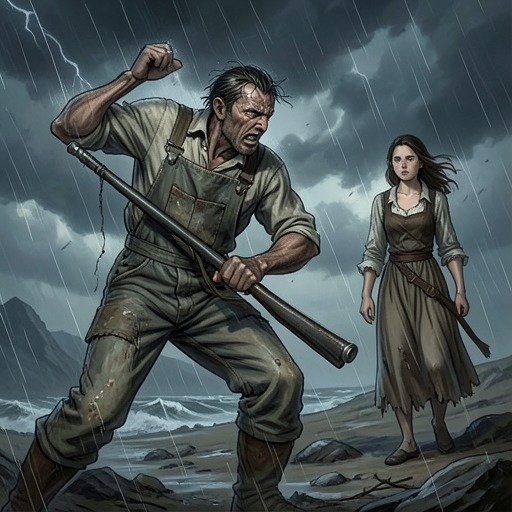
Kya considers her mother’s departure through an analogy Jodie had once given her: a fox may abandon its young under extreme stress, increasing its own chance of surviving to breed later. Kya has since read about how apparently harsh behavior in nature can pass on survival advantages, and she extends that reasoning to human beings and inherited instincts. She imagines that the danger and stress of living with Pa may have driven their mother to leave. The explanation makes it possible to understand the departure as shaped by survival without calling it right; Kya remains troubled that her mother did not return or send letters.
The reunion concentrates loss and connection in the same moment. Kya says that she has had no family and no family news for most of her life, and that within minutes she has found a brother and lost her mother. She then tells Jodie that she had, in a sense, lost their mother years earlier, while his return is one of the happiest and saddest days of her life. Her rare touch on his arm marks a small, concrete opening toward another person. Isolation has not disappeared, but Kya can now hold grief, forgiveness, uncertainty, and the relief of reunion together without pretending that one cancels the others.